Why Blogs and Newsletters Are Winning
June 12, 2026
Rented audiences are eroding. The brands compounding fastest are building owned media: blogs and newsletters working as one system. Here is what we see across the agency floor, and how to build the foundation before the window closes.

There is a structural shift happening across digital marketing right now, and most operators have not priced it in yet. It is not seasonal. It is not a trend. It is not a creator-economy story or an e-commerce story. It is a foundational rewrite of where attention lives, where trust accumulates, and where revenue actually originates.
The playbook most brands still run goes like this: post more, post better, chase the algorithm, layer in paid, hire an influencer, repeat. That playbook is not dead, but it is bleeding out. CPMs are climbing. Organic reach is collapsing. Trust in sponsored content is sliding. AI is rewriting how discovery works. And the businesses quietly compounding revenue while everyone else fights over shrinking organic reach are doing something fundamentally different.
They are not louder. They are not more viral. They are not better at hooks. They are building owned media infrastructure; and they are doing it through two channels everyone wrote off a decade ago: blogs and newsletters. Not separately. Together. As a system.
If your business depends on a feed, your business depends on a stranger.
What we see across the agency floor
Parlay Collective sits at the intersection of two perspectives most marketers never get to compare side by side. We watch how brands spend. We watch how creators earn. Both sides are telling us the same story right now.
The brands compounding fastest are not the ones with the biggest paid budgets, they’re the ones with the biggest owned audiences. The creators building the most stable income are not the ones with the biggest follower counts, they’re the ones with the biggest subscriber lists. The e-commerce companies surviving the CAC squeeze are not the ones doubling down on Meta, they’re the ones who realized email and SEO traffic do not expire when the budget runs out.
The common thread is ownership. The common thread is infrastructure. The common thread is a willingness to invest in things that do not go viral. Blogs and newsletters are not nostalgic. They are the most quietly powerful revenue channels in modern marketing, and the data has crossed the line from interesting to undeniable.
Owned audiences are now worth more than social reach. The math is no longer close.
One of the biggest unspoken misconceptions in marketing is that follower count equals audience ownership. It does not. It never did. The difference just got impossible to ignore.
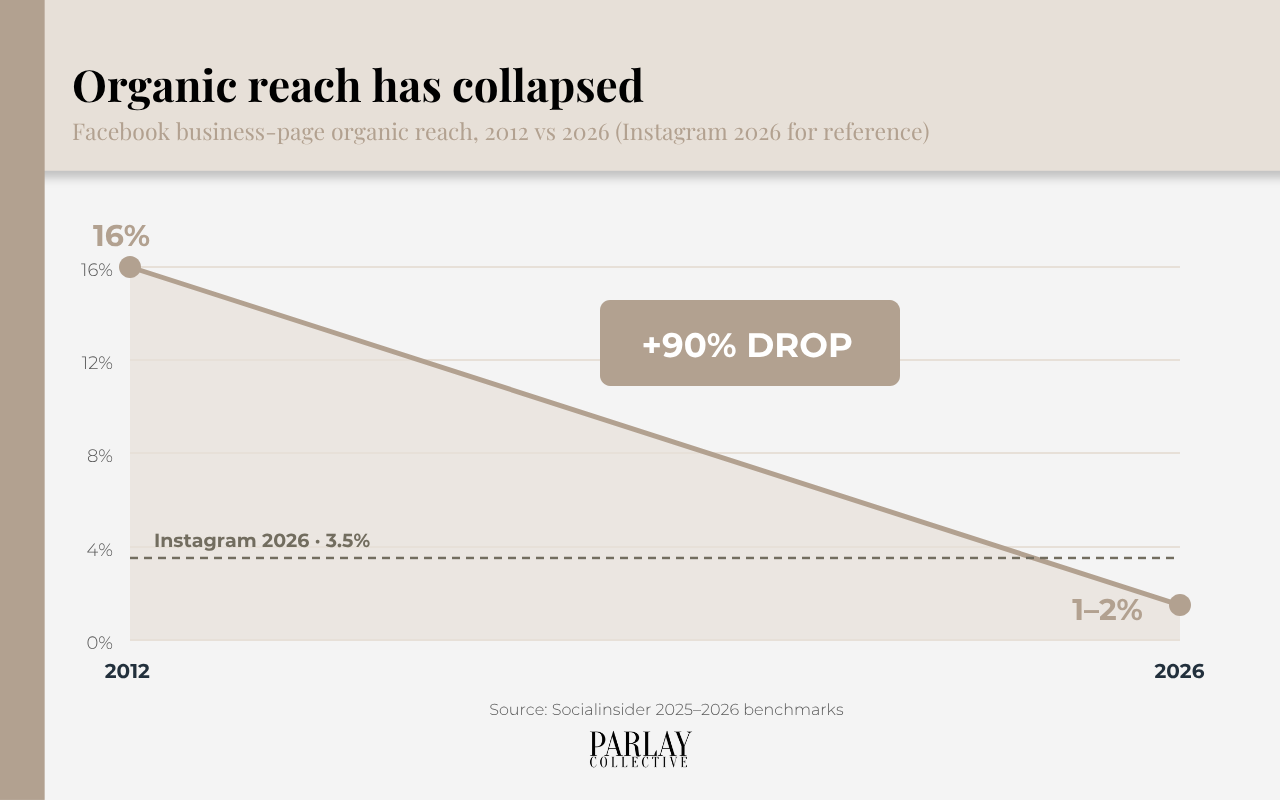
A creator with 500,000 Instagram followers does not control communication with those 500,000 people. A brand with 100,000 TikTok followers does not own distribution to its followers. Visibility is rented. The lease terms change quarterly. And the rent keeps going up. Here is what the numbers looked like through 2025 and where they are heading in 2026:
- Instagram organic reach for business accounts averaged 3.5% per Socialinsider’s 2025 benchmarks, with no meaningful improvement in early 2026 data.
- Facebook organic reach now sits between 1% and 2%. For context, Facebook averaged 16% reach in 2012 which is an order-of-magnitude collapse in roughly a decade.
- Meta’s median CPM hit $13.48 in 2025, up 20% year over year. U.S. CPMs nearly doubled from $10.84 to $19.66 across the same window; an 81% jump in the cost of buying back attention brands used to earn for free.
- E-commerce customer acquisition costs climbed 40% to 60% between 2023 and 2025, the steepest short-term CAC climb the industry has ever recorded. The 2026 trajectory is not slowing it.
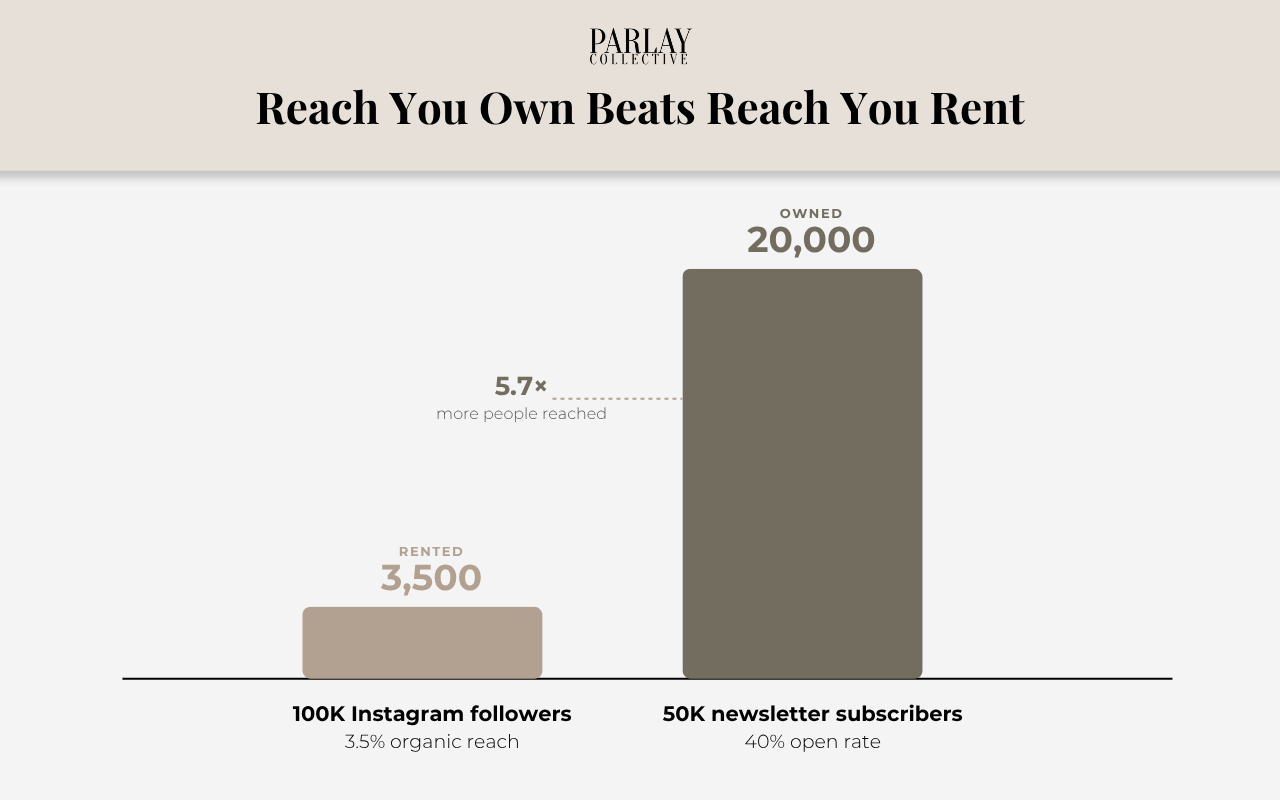
Translate that for the operator. An Instagram account with 100,000 followers organically reaches around 3,500 people on a typical post. A Facebook page with the same following reaches maybe 1,000 to 2,000. Now compare a newsletter: 50,000 subscribers at a 40% open rate puts the message in front of 20,000 people who chose to receive it. No algorithmic dampening. No CPM. No paid amplification. No platform deciding who deserves to see the content this week.
Twenty thousand intentional impressions versus thirty-five hundred algorithmic impressions, on the same starting follower count. That is not a content problem. That is a business-architecture problem.
The followers are not yours. The list is. Stop optimizing what you do not own. Once that lands with a founder or creator we work with, the rest of the strategy rearranges itself.
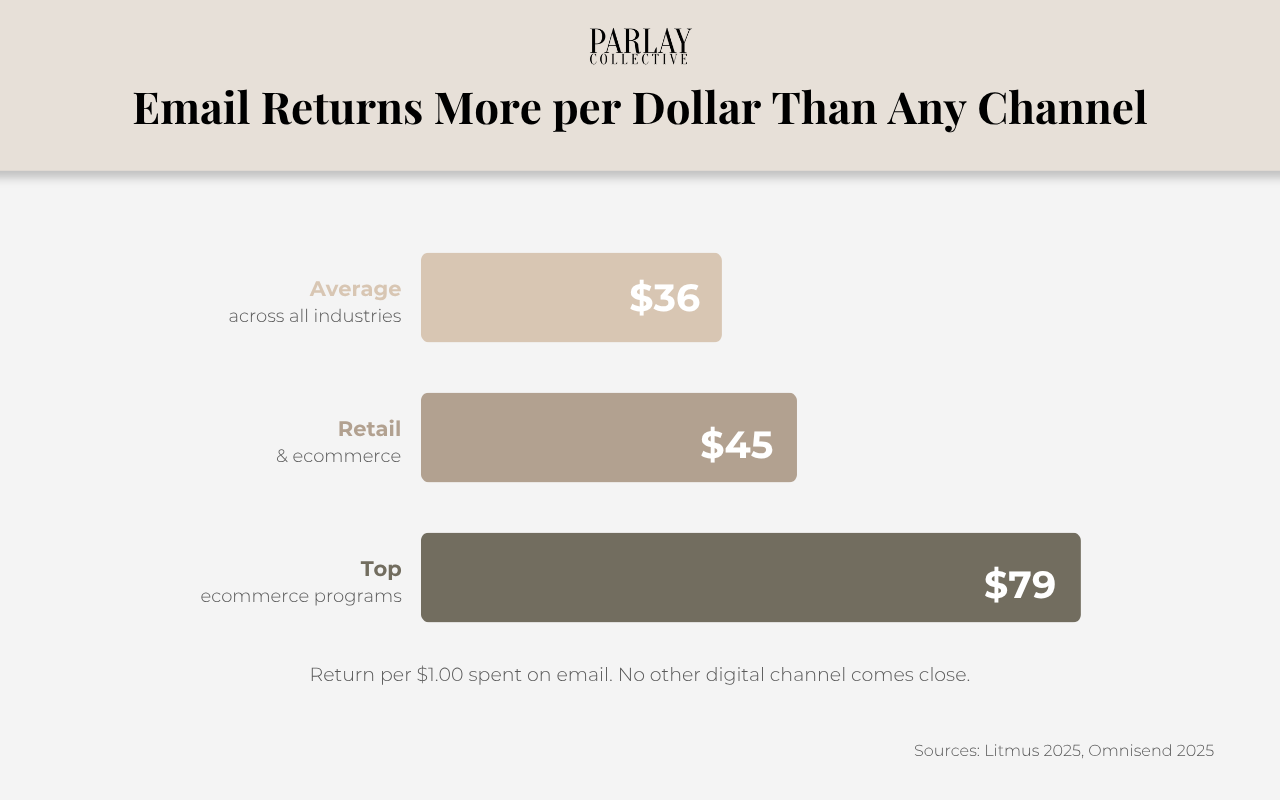
Email still outperforms every other digital channel and the gap is widening.
Email continues to deliver the highest reliable ROI of any digital channel, and the case got stronger, not weaker, as paid costs climbed. Litmus’s 2025 State of Email report showed email returning $36 for every $1 spent on average, and as much as $45 per $1 in retail and e-commerce. Omnisend reported merchants on paid plans averaging $79 per $1 in 2025. Klaviyo’s data showed automated flows generating roughly 41% of total email revenue from just 5.3% of sends. That means the highest-leverage email a brand sends is the one nobody on the team has to write that week.
Run the math at agency scale. A brand spending $25,000 annually on email tools, list growth, automation, and newsletter production can realistically influence $900,000 to $1.1 million in revenue over time. There is no other channel in the digital build where the math is that lopsided in the operator’s favor. None.
And open rates have not collapsed the way every “email is dead” take predicted. Mailchimp’s 2025 benchmarks put average open rates between 35% and 45%, with health and fitness lists averaging 47.8%, nonprofits 52.4%, and consulting 46%. One honest caveat: Apple’s Mail Privacy Protection inflates open-rate reporting, so click-to-open rate is now the cleaner signal. But the underlying truth holds. When someone subscribes, they actually want to hear from you. That is not true of any other channel in the mix.
This is why every sophisticated brand collects email at checkout, loyalty enrollment, pop ups, lead magnets, gated guides, consultation forms, account creation, giveaways, content upgrades, and referral systems. They understand something most smaller operators still underestimate. The audience you can reach directly compounds in value over time. The audience you have to pay to reach decays.
How to start: Pick the platform that fits the business. Klaviyo for e-commerce because of its Shopify integration and behavioral triggers. Flodesk for creators and service brands that need design driven sends. ConvertKit or Beehiiv for creators building paid newsletter businesses. On day one, set up three flows: a welcome sequence that introduces the brand and converts a meaningful share of new subscribers within seven days, an abandoned cart or browse abandon sequence if there is anything to buy, and a post purchase sequence that turns a first time buyer into a repeat buyer. Commit to a weekly send. Do not skip a week. Cadence is what builds the relationship.
Why blog traffic converts differently than social traffic and why that gap is permanent
The cleanest way to understand the difference comes down to one word: intent. Social users scroll. Search users seek. That is not a semantic distinction; it is a commercial chasm.
A social user is half-watching while multitasking across entertainment, DMs, and a dozen open tabs. A search user is sitting forward, decision in mind, ready to act. Someone Googling “best agency for influencer campaigns” or “how to start an email newsletter” is already three-quarters of the way down the funnel. They are not asking to be entertained. They are asking to be helped.
This is why long-form blog content consistently outperforms short-form interruption content on the metrics that matter for a business: trust, conversion quality, and revenue per visitor. Educational content earns trust before asking for action. Trust collapses friction. Friction is where most conversions die. And unlike paid advertising (which disappears the moment the budget pauses) a well-built article keeps producing for months and years.
Run a conservative model. A blog article pulling 5,000 monthly visits, converting just 2% of readers into subscribers, produces 100 new subscribers per month (1,200 per year), from a single article. Layer that across 20, 50, 100 articles. Then layer in monetization through products, partnerships, services, sponsorships, or affiliate placements. That is no longer content marketing. That is infrastructure.
A social post fades in 48 hours. A blog post earns for 48 months.
How to start: Pick five queries an ideal customer is typing into Google right now. Write one 2,000 word post per week answering those questions with real expertise, not generic SEO filler. Build the post with a hook in the first 100 words, a clear structure with H2 and H3 headers, internal links to related posts on the site, an email opt in inside the post, and a call to action at the end. Drive traffic to each post from Pinterest pins, Instagram story callouts, and newsletter mentions. Republish quarterly with updated stats and links so the content stays fresh in the index. Compounding starts at roughly post 20 and accelerates from there.
GEO is the new SEO and almost nobody has caught up yet.
There is a layer sitting on top of everything above, and it is the most important shift in discovery since Google itself: AI now answers the question before the reader ever clicks.
When someone asks ChatGPT “best email platform for creators” or “how to start a newsletter,” they do not get ten links to weigh. They get a synthesized answer that names a few sources. If your blog is one of them, you captured the customer at the exact moment of decision. If it is not, you do not rank low—you do not exist.
That is Generative Engine Optimization. SEO got you ranked. GEO gets you cited. ChatGPT serves over 800 million weekly users. Google’s AI Overviews now appear on up to 60% of searches. Roughly 42% of informational queries in early 2026 ended in zero clicks, because the AI had already answered. The question is no longer whether you rank. It is whether the machine quotes you.
Here is the part that should reframe everything: AI engines cannot cite a feed. They cannot cite a Reel. They build answers from structured, authoritative, indexed content; and the strongest source for that is an owned blog written by a real expert. Social cannot be pulled into an AI answer. Your blog can. The owned infrastructure this whole piece is about is not threatened by AI search. It is the only thing positioned to win it.
And the traffic it sends is the best that exists. AI-referred visitors convert at four to sixteen times the rate of standard organic search, because the AI has pre-qualified them by recommending you. One analysis found AI visitors were half a percent of total traffic but 12% of signups. Honest caveat: AI referral traffic is still small in absolute terms today (around 1% of all web traffic) but it is growing roughly 1% month over month and converting at multiples of everything else. Small, accelerating, and disproportionately valuable is exactly the profile you want to be in front of.
The opportunity is the gap. 92% of marketers say they plan to optimize for AI search. Only about 40% actually do it, and only 14% track it at all. That gap is the first-mover advantage, except this window is younger and wider than any other channel here.
How to start: Write with real data and cite sources; a Princeton-led study found original statistics, direct quotations, and citations make content up to 40% more likely to be surfaced in AI answers. Answer the actual question inside the first 100 words, since that is where AI engines pull most citations. Structure posts with clear, question-based H2 and H3 headers the AI can lift cleanly. And build authority off your own site through mentions on LinkedIn, Reddit, and credible publications. Every post you were already going to write becomes a GEO asset the moment you write it this way.
The psychology nobody names: intentional discovery beats interruption every time
The deeper reason blogs and newsletters are pulling ahead is psychological. Consumers are not just exposed to more marketing than ever, they are fatigued by it. They have learned to scroll past ads, skip sponsored content, and treat interruption as noise.
But the same consumer who scrolls past a sponsored post will sit and read a 2,000-word guide comparing two products. They will subscribe to a newsletter that gives them perspective they actually want. They will return weekly to a brand that teaches them something useful, and they will buy from the brand whose content they have come to trust. Search behavior is intentional. Newsletter subscription is intentional. Almost everything else is interruption.
Repeated-exposure theory does the rest. The more consistently someone encounters your perspective, your recommendations, your voice, the more familiar your brand becomes. Familiarity reduces friction. Reduced friction increases trust. Trust increases conversion. Blogs and newsletters are the only two channels that compound on repeated exposure without paying for every impression.
The creator economy is leaving the influencer model behind. Owned media is the new ceiling.
Creators feel this shift before traditional brands do, because creator income reflects platform behavior in real time. Reach changes, revenue changes. Algorithm shifts, payouts shift. The creators we see building the most durable businesses are not chasing follower counts. They are quietly building owned media on top of their social presence: Substack, Beehiiv, personal blogs, affiliate-monetized SEO content, memberships, editorial archives.
The economic logic is simple. Social media introduces. Blogs capture. Newsletters convert. The blog builds the revenue floor. The newsletter builds the revenue spikes. The social presence is the discovery layer feeding both.
The math is real. A creator with 50 evergreen monetized articles (each generating 3,000 monthly visitors, a 5% affiliate click rate, a 4% conversion rate, and an $18 average commission) produces roughly 150,000 monthly readers, 7,500 outbound clicks, 300 purchases, and $5,400 per month from affiliate alone. That is over $64,000 a year, before sponsorships, products, courses, or partnerships. Add a newsletter of 40,000 subscribers at a $40 CPM and one weekly sponsored placement, and that is another $6,400 monthly, which is over $76,000 a year from sponsorships alone.
Layer them and the creator transitions from “influencer,” a label that puts leverage with the platform, to “media owner,” which puts leverage with the creator. The creators who finish that transition early will spend the next five years pulling away from the ones who do not.
What e-commerce brands get wrong and what the smartest ones do instead
E-commerce is the cleanest place to see the financial impact, because every interaction maps to revenue. Blogs reduce uncertainty before the first purchase. Newsletters increase repeat behavior after it. A skincare brand publishing ingredient education reduces hesitation. A fashion brand publishing styling frameworks raises basket size. None of that content is a sales pitch, yet all of it sells.
The data is decisive. Email typically drives 20% to 30% of total e-commerce revenue, and as high as 40% for top performers. If an email program is not producing at least 25% of revenue, the program is under-built, not the channel. Abandoned-cart recovery is where the gap between average and operator is brutal: typical brands recover 3% to 5% of carts; top performers recover 10% to 14%, with cart emails opening above 41%.
Run it on a mid-sized store: 10,000 abandoned carts monthly, a 10% recovery rate, a $95 average order value. That is 1,000 recovered orders and $95,000 in recovered monthly revenue ($1.14 million annualized) from a single automated flow you build once. This is what we mean when we say blogs and newsletters are infrastructure, not campaigns. They produce while you sleep.
How we start a client: Audit the existing email program against top-performer benchmarks. Build the four foundational flows: welcome, abandoned-cart and browse-abandon, post-purchase, and win-back. Segment by purchase history, behavior, and engagement. Move from one weekly broadcast to two, then layer in promotional and educational sends on a published calendar. Inside six months a properly built program should drive at least 25% of total revenue.
The agency and service-business play: authority before proximity, proximity before purchase
Service businesses operate on a different buying cycle than e-commerce, but the same owned-media infrastructure unlocks the growth. The service buying cycle is dominated by five factors: trust, authority, visibility, timing, and familiarity. Prospects research extensively, compare, observe, and quietly track three or four firms for months before sending the first email.
Firms that document their thinking publicly build authority before the first sales conversation. By the time the call happens, the prospect is no longer evaluating whether to work with you; they are confirming how. Newsletters then handle the timing problem. A prospect might read a post today and not be ready to hire for three, six, or twelve months. Without continuous communication, that lead evaporates.
Newsletters prevent the evaporation. They are not a promotional channel (that framing is exactly why most service businesses build them badly). They are a proximity channel. They keep your perspective in the prospect’s inbox until the day they are ready to act. That day always comes. The only question is whether you are still in the conversation when it does. This is why Parlay Collective treats a client’s newsletter list as a strategic asset, not a broadcast list.
How we start a client: Pick a weekly publication cadence (weekly is ideal, biweekly is the floor). Pick three content pillars based on the questions answered most often in sales calls. Document the thinking in long form on the blog, send it to the list, and cross-post excerpts on LinkedIn. Inside 12 months, inbound pipeline from the blog and newsletter should match or exceed pipeline from outbound, referrals, and paid combined.
The four phases of owned-media maturity
After watching enough brands and creators move through this transition, the progression is predictable. Most operators stall between Phase 1 and Phase 2, which is exactly where the compounding stops working.
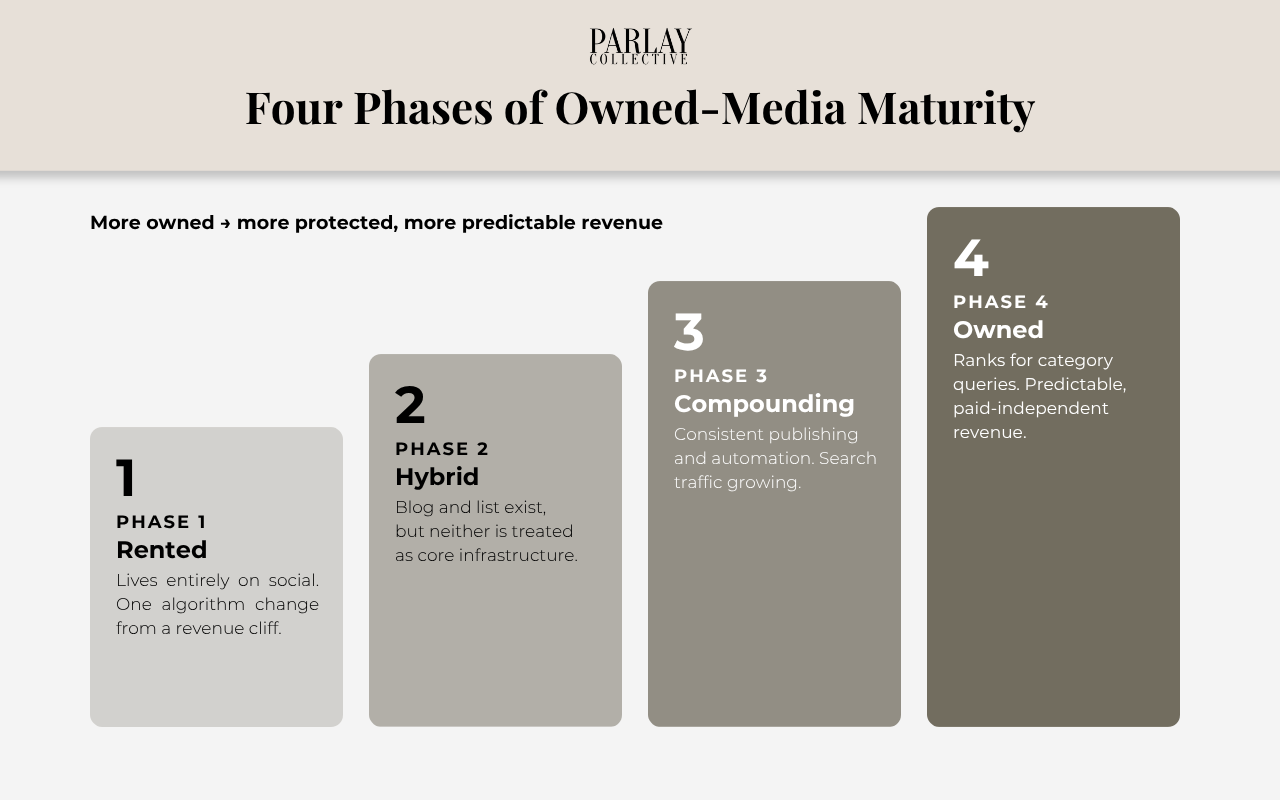
Phase 1: Rented attention.
The business lives entirely on social. Reach depends on algorithms; revenue depends on launches, viral moments, and paid. The business is one platform change away from a revenue cliff. Most operators are here.
Phase 2: Hybrid presence.
There is a blog and an email list, but neither is treated as core infrastructure. Posts go up sporadically. Newsletters send only when there is something to sell. The list is not segmented. Most brands are technically here but operationally still in Phase 1.
Phase 3: Compounding infrastructure.
The blog publishes consistently against a real search strategy. The newsletter sends on a reliable cadence. Automation runs. Search traffic grows. Revenue starts coming from owned channels rather than just being announced through them. This is where marketing stops feeling like a treadmill.
Phase 4: Owned distribution.
The blog ranks for category-defining queries. The newsletter is a publication with its own identity. The list is segmented, monetized across multiple layers, and producing predictable revenue independent of paid. Social is now an amplification layer feeding the owned ecosystem. Almost every business that reaches Phase 4 became dominant in its category within 24 to 36 months. Compounding rewards consistency, and most competitors quit before it starts.
The five mistakes we see brands and creators repeat
- Treating the newsletter like a sales channel instead of a perspective channel. Lists die when every send is a promotion and thrive when subscribers get something they could not get from a feed. Lean heavily toward perspective and education; layer promotion around launches and seasonal moments.
- Writing for “the algorithm” instead of the reader. Search rewards depth, expertise, and originality more than ever, and AI discovery is accelerating that shift. Google’s Helpful Content updates repeatedly demote thin, derivative content in favor of first-hand experience. Brands that write for the reader rank for the reader.
- Building an email list with no segmentation. A list of 50,000 undifferentiated subscribers is worth a fraction of 20,000 properly segmented ones. Segment by purchase history, behavior, source, engagement, and product interest. That alone usually doubles email revenue inside 90 days.
- Publishing inconsistently. Compounding does not work on stop-and-start cadences. One good post per week for two years beats four mediocre ones per week for six months and then quitting. Pick a cadence the team can sustain through busy seasons.
- Failing to convert social discovery into owned subscription. A follower is a maybe; a subscriber is a yes. Bio links should go to a lead-capture page, not a homepage. Story callouts drive to opt-ins. Every social touchpoint is a doorway to the owned foundation and most operators leave that door closed then wonder why their owned audience never grows.
What this looks like 24 months from now
Forecasting in marketing is mostly noise, but the trajectory of this shift is clear enough to call. Paid acquisition costs will keep climbing. Organic reach on legacy social will keep compressing. AI-powered discovery will keep redistributing traffic toward primary sources, which favors brands publishing real expertise on their own domains. Trust in interruption advertising will keep eroding. And the gap between brands with owned audiences and brands without will widen meaningfully.
Two years from now, the brands that started compounding in 2025 and the first half of 2026 will be in a categorically different competitive position than the ones that waited; with search authority, segmented lists, and monetization layers competitors cannot buy past with paid spend. The opportunity window is not closing tomorrow. But it is closing. The cost of starting goes up every quarter you wait, because every quarter the established players publish more, rank for more, and capture more of the searchable surface area in their category.
The next phase
The next phase of digital growth will not belong to the brands that produce the most content. It will belong to the brands that own the strongest communication channels. Blogs anchor knowledge. Newsletters anchor relationships. Everything else such as social, paid, influencer partnerships, short-form video, and PR becomes amplification layered on top of owned infrastructure.
This is why blogs and newsletters matter more right now than at any point in the last fifteen years. Not because they are new or trendy, but because they are stable, owned, searchable, monetizable, and compounding. Every other channel rents your attention. These two build your equity.
Social amplifies. Blogs anchor. Newsletters sustain.
Together, those three layers create visibility that compounds, communication that persists, trust that deepens, and revenue that becomes meaningfully more predictable over time. That is not marketing. That is a business advantage, and it is the one we build for every brand and creator we partner with.
Build the infrastructure. Own the channel. The era of rented audiences is ending. The era of owned media is just getting started.
Work with Parlay Collective
Parlay Collective builds owned-media infrastructure including blog strategy, SEO and GEO, email and newsletter systems for creators, brands, and service businesses ready to stop renting their audience.


Statistics referenced above are drawn from public sources reported through 2025 and confirmed in early 2026: Socialinsider (Instagram and Facebook organic reach benchmarks), Meta and industry CPM data published by Revealbot and AdEspresso (Meta CPM and CPC trends), eMarketer and Shopify Plus (ecommerce CAC trends), Litmus 2025 State of Email Report (email marketing ROI), Omnisend (ecommerce email benchmarks), Klaviyo (automated flow contribution to email revenue), Mailchimp 2025 Industry Benchmarks (open rates and click rates by industry), Apple (Mail Privacy Protection impact on open rate reporting), Sacra and Backlinko (Substack subscriber and revenue data), and the DMA (long run email ROI benchmarks).Most full year 2026 figures will not be confirmed until end of year reporting cycles complete in Q1 2027. Where 2026 trajectory is referenced above, it is based on early 2026 reporting trends being tracked against in year benchmarks. Every figure above is drawn from public, dated sources. None of the numbers in this piece are anecdotal.
Be the first to comment